Snow and drift
Roof snow load is set from the code's ground snow load for your site, then raised where snow drifts: against a taller wall, behind a parapet, or where a lean-to steps down from the main roof.
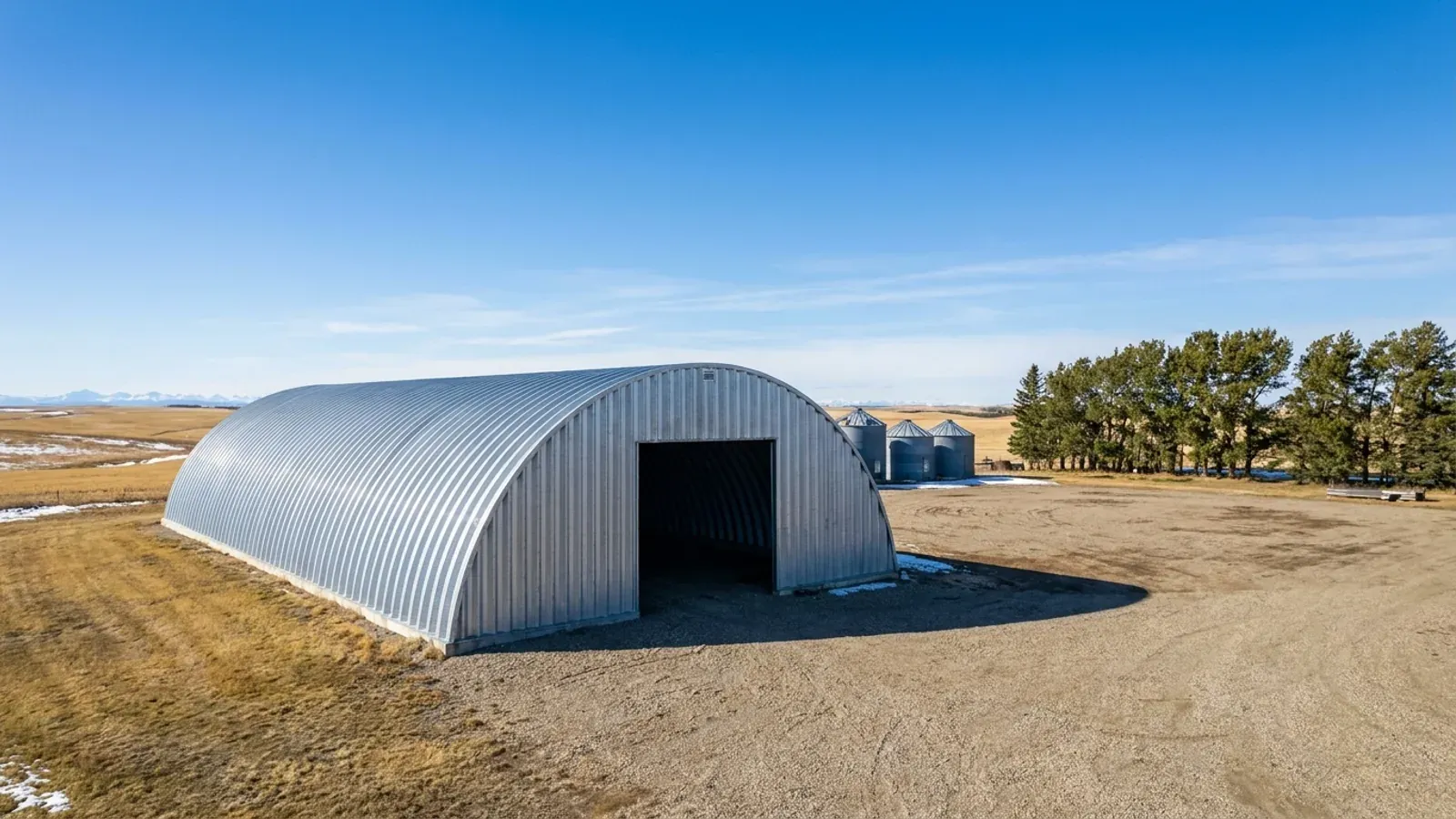
A quonset is an arch-shaped steel building made from curved, corrugated steel panels that carry the load themselves, with no separate frame. They are a familiar sight on Alberta farms and a popular search for anyone pricing storage. We supply arch buildings as kits or erected, and we will tell you plainly when a straight-wall steel building would serve you better.
A quonset is the arch-shaped building most Albertans picture on a grain farm: a half-round or pointed-arch shell of corrugated steel panels bolted together, with flat end walls carrying the doors. The curved panels are both the structure and the cladding, so there are no frames, purlins or girts. In Alberta, "quonset" has become the everyday name for any arch building of this kind.
Structurally, the panels are cold-formed steel. The National Building Code – 2023 Alberta Edition requires buildings and members made of cold-formed steel to conform to CSA S136, the North American specification for cold-formed steel structural members. A straight-wall pre-engineered steel building is different: its rigid primary frames carry the loads, and cold-formed purlins and girts span between them to support the cladding.
A quonset is efficient at enclosing volume for storage. With no posts inside and no separate frame, it is quick to assemble and it sheds snow off the sides. For a farmer storing grain, hay, or machinery that drives in through an end wall, it is a proven answer. It also suits owners who want a simple cold-storage building and have the crew to bolt one together. Because the shell is the structure, there is also less to go wrong in assembly: panels bolt to panels, and the arch goes up in sections. Grain and bulk materials can be pushed right to the walls, where the curve doesn't get in the way the way it does for shelving.
The curve is the limitation. Near the walls, the roof comes down to the floor, so the full width is only usable in the middle. Shelving, benches, mezzanines and tall equipment don't fit along the sides the way they do in a straight-wall building. Large doors can only go in the end walls, not the sides. Insulating and lining a curved shell is harder than insulating a flat wall and roof, and a heated workshop in a quonset fights condensation on all that cold steel. Adding a lean-to or a sidewall door later is not practical.
If the building is a shop, a commercial space or anything with people working along the walls, a straight-wall building usually gives more usable floor for the same footprint. See our acreage shops page and the 30x40 shop page for how a straight-wall building lays out.
A curved roof doesn't hold snow the way a flat or gable roof does. The building code has a specific article for arch roofs, curved roofs and domes. Every arch roof has to be checked for full and partial snow loading, and arches above a minimal rise also have to be designed for uneven loads, with snow building up on the downwind side of the peak. Snow that slides off a curved roof also piles against the base of the walls, which matters for doors and for anything stored against the outside.
That is why a quonset bought on price from a catalogue is risky. Ask for drawings designed for your site, stamped by a professional engineer, and ask whether the manufacturer is certified to CSA A660, the standard the code uses for manufacturers of steel building systems.
A quonset is treated like any other building. On a working farm, used for the farm's own equipment, livestock, materials or produce, with low human occupancy, it may fall under the building code's farm-building exemption; our agricultural buildings page explains the limits. On an acreage that isn't a farm, or on commercial land, the building permit process applies, and your municipality's land-use bylaw still decides where it can go.
We start with what goes inside and how it gets in. A quonset suits bulk storage and equipment that comes through the end walls; it suits a workshop with shelving along the walls much less well.
We compare the arch building with a straight-wall steel building of similar footprint, looking at usable width near the walls, door positions, insulation and future additions.
The arch is designed for the snow and wind at your location, including the uneven snow loads curved roofs attract. Drawings are stamped by an Alberta-registered professional engineer (P.Eng.) retained by the building manufacturer.
End walls are framed separately and carry the doors. Their size and position are set before the order is placed.
The arch panels bolt to a base on a footing or slab, and the arch is assembled in sections and stood up, then the end walls are framed and clad.
Roof snow load is set from the code's ground snow load for your site, then raised where snow drifts: against a taller wall, behind a parapet, or where a lean-to steps down from the main roof.
Wind pressure is set from the code value for your site and its exposure. Large doors, end walls and anchor bolts are designed to it, not to a catalogue default.
Southern Alberta sees some of Canada's most damaging hail. Ask for wall and roof panels carrying a UL 2218 Class 4 impact rating in the manufacturer's listing, and check the paint system's warranty terms for hail.
| Size (ft) | Floor area | Typical use | Framing |
|---|---|---|---|
| 30x40 | 1,200 sq ft | Two-bay garage shop, hobby shop, small equipment storage | red iron or light gauge |
| 40x60 | 2,400 sq ft | Acreage shop with RV or equipment bays, small contractor shop | red iron or light gauge |
| 60x100 | 6,000 sq ft | Contractor yard building, machine storage, small warehouse | red iron |
| 100x200+ | 20,000 sq ft | Warehouse, crane-served fabrication shop, riding arena | red iron |
Every size is a starting point. Width, length, eave height and frame spacing are set to your use and your site.
Every municipality has its own permit route. See all the places we build.
A quonset is a steel building with no frame: curved steel panels form the walls and roof together. A straight-wall steel building has rigid primary frames with purlins and girts carrying flat roof and wall sheets. The arch is efficient for storage; the straight wall gives full usable width, sidewall doors and easier insulation.
Unless the farm-building exemption applies, yes. A quonset on a farm, serving that farm's own livestock, equipment, materials or produce, with low human occupancy, may be exempt from the building code. On an acreage or commercial property it needs a building permit, and the county may require a development permit.
You can, but it is harder than in a straight-wall building. The curved shell is awkward to insulate and line, and warm, moist air meeting cold steel causes condensation. If you plan to heat the building and work in it all winter, compare it with a straight-wall building before you decide.
The building code requires arch and curved roofs to be checked for both full and partial snow loading, and arches with more than a minimal rise must also be designed for uneven loads that build up on the downwind side. The manufacturer designs for your site's snow load; the figure comes from the code's climatic data for your location.
The pages that answer the next question this one raises.
The farm-building exemption explained, and straight-wall options for machine and hay storage.
Read itIf you are comparing every type of farm building, not just arch versus straight wall.
Read itHow a straight-wall building of a common quonset size uses its floor.
Read itGive us the size, the use and the site, and we'll reply with framing options, the permit route for your municipality and a quote.
We use the details you send to answer your quote request and, if you go ahead, to order and build your building. If we can't take on your project and you tick the partner-builder box, we share your details with an independent supplier or erector in Alberta who can quote it. Our form and contact system is hosted by a service provider in the United States. See our Privacy Policy for details and for who to contact with questions.